
Getting St. James Parish Court Records
One office answers for district-court files here. The St. James Parish Clerk of Court serves as the records counter for the parish side of the 23rd Judicial District Court. Civil, criminal, family, and succession matters all run through it. Before calling, name the case and the specific item you want. The Clerk advertises no general public civil or criminal docket search. CottFile handles e-filing and submission status. It is not a confirmed open docket viewer. re:SearchLA is a statewide product worth a try, though St. James participation is unconfirmed in official sources.
The reliable route runs through people. Use the Clerk counter, the published civil or criminal phone line, mail, or an email found in the clerk directory, and put the request in writing when it helps. The parish GovQA portal accepts public-records requests generally. But a court-file request should still name the Clerk. A justice-of-the-peace or mayor's-court file stays with that small court. It does not move to the district Clerk by default.
- Identify the venue, division if known, approximate year, case type, and the particular docket entry or document sought.
- Call the Clerk's civil or criminal line to ask whether the public record is available for inspection and which request route fits it.
- Use the Convent counter for in-person inspection, or confirm mail, email, and payment instructions before sending a written request.
- Test re:SearchLA only as a statewide fallback, and treat an empty result as unconfirmed because St. James participation was not verified.
- Ask whether the result should be a viewable docket, a plain copy, or a clerk-certified copy before a fee is paid.
Note: A published fax number for the Clerk does not mean every court-record request can travel by fax. Confirm before sending.
St. James Parish Clerk Court Records
Three parishes share one district court. St. James Parish sits in the 23rd Judicial District Court along with Ascension and Assumption. But that shared structure gives no Ascension or Assumption office authority over St. James records. The St. James Parish Clerk keeps the district filing and docket records. Those cover the parish's cases. Below that level sit seven justice-of-the-peace courts. The mayor's courts also maintain their own limited dockets. A hearing question may also go straight to the assigned division.
St. James Parish Clerk of Court
5800 LA Highway 44, 2nd Floor
Convent, LA 70723
Civil: 225-562-2270 or 225-562-2360
Criminal: 225-562-2389 or 225-562-2271
Precision makes a records request move faster. Ask for the "public docket," the "signed judgment," the "filed petition," or another named item rather than a vague request for everything. Mail reaches the Clerk at P.O. Box 63, Convent, LA 70723. The office publishes no request-specific instructions or payment details, so confirm both before anything goes in the mailbox.
Court Record Types
A court record is never just one paper. Think of the docket as the running event history. The case file is the papers behind those events. A good St. James Parish request names both the layer and the court. Recorded land instruments sit in a separate category. Even so, the same Clerk carries broader parish-record duties.
- Docket or register: dated filings, settings, orders, and disposition references in one case.
- Filed pleadings: petitions, answers, motions, exceptions, and supporting papers.
- Orders and judgments: signed court directives or adjudications that may need certification.
- Evidence, exhibits, and transcripts: material that can be separate, restricted, voluminous, or unavailable online.
- Financial and cost records: case-specific fees, fines, restitution, bond, or balance information when the custodian maintains it.
- Recorded land documents: conveyances and mortgages indexed through the Clerk's distinct land-record channels.
Where the case lives decides where to ask. A Gramercy or Lutcher municipal-ordinance matter, or a limited case in a justice-of-the-peace district, belongs to that court alone. A district docket query will not pull those records in.
St. James Parish Court Records: Land Portals
The Clerk's own Records page states its scope plainly: "Conveyance and Mortgage Records only." That line matters for routing. The page links the LCRAA portal and Cott Hosting for recorded instruments and indexing. Yet it offers no public civil or criminal court-docket search. Treat a name in a land index as just that. It is not a district-court case result. A missing name proves no absence of a case.
The official records-page display draws the advertised line between St. James Parish land records. Actual court files sit on the other side.
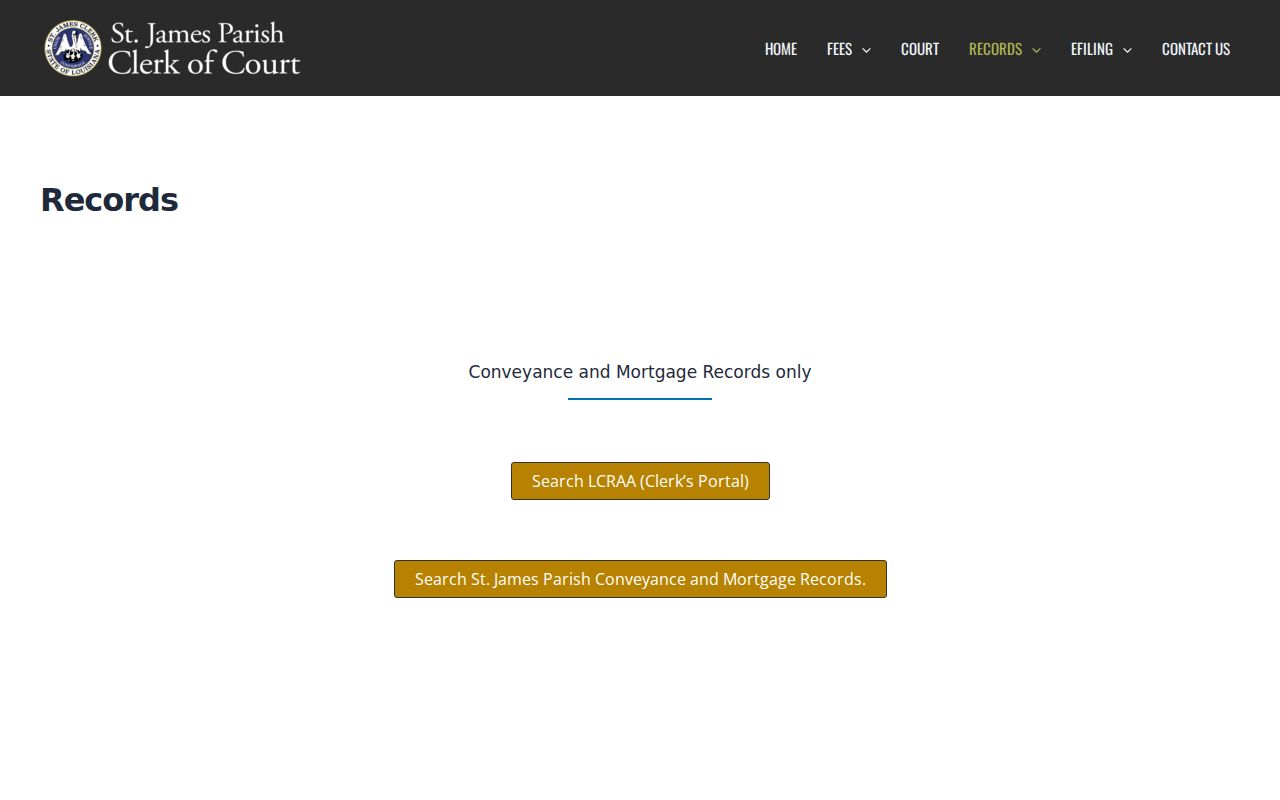
Let the page do its land-record job. Then contact the Clerk directly for a St. James Parish district court docket or a filed document. The LCRAA records portal gateway serves recorded instruments too, not a St. James district-court register.
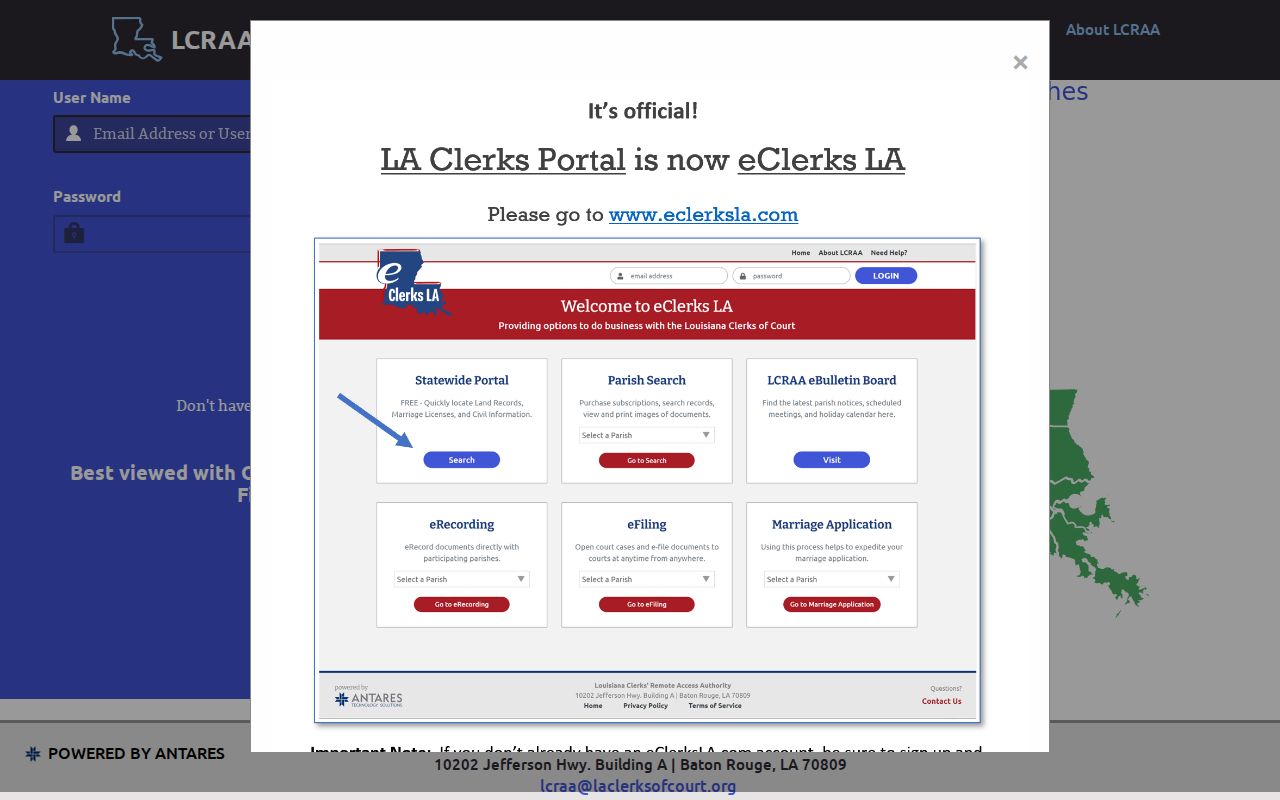
Statewide clerks infrastructure can help with participating land-record access. The Clerk's own description still governs where the St. James court-record boundary sits. The St. James Cott Hosting page belongs to that same conveyance and mortgage channel.
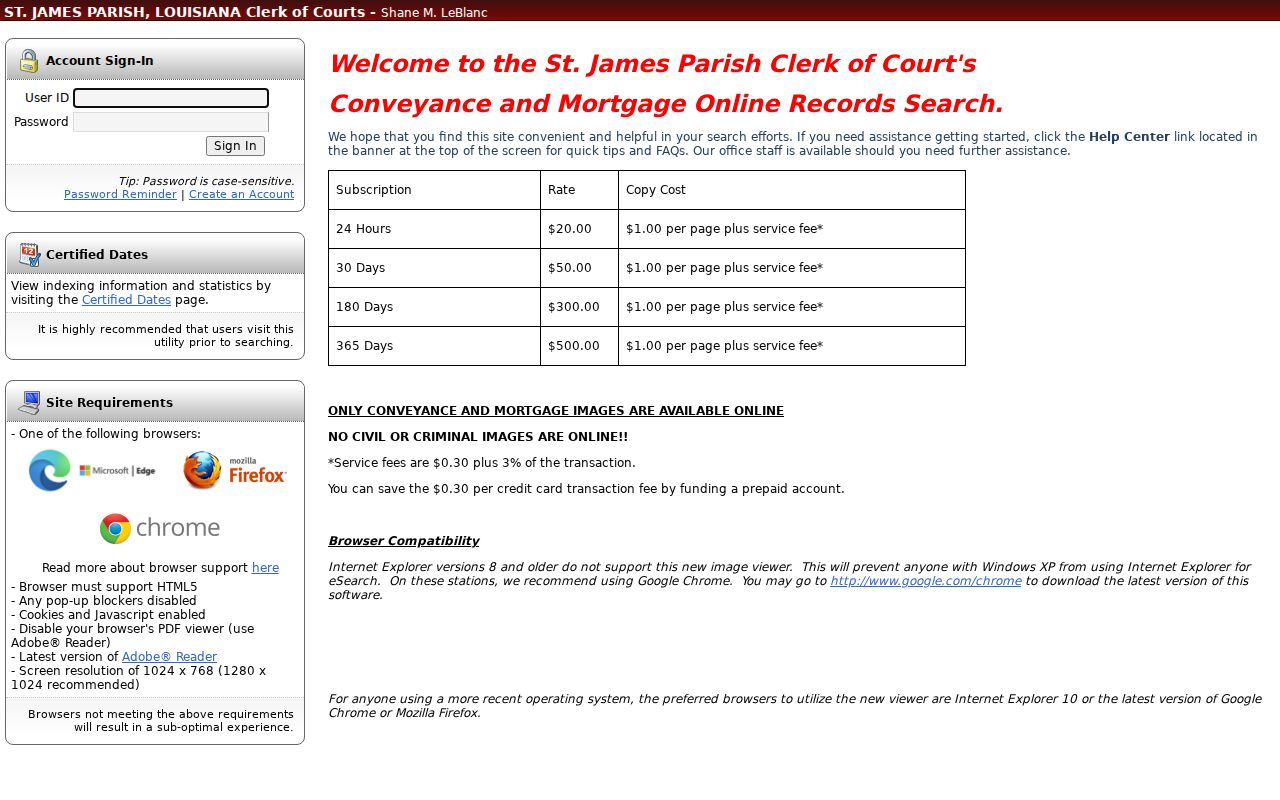
None of these land portals should be called a civil, criminal, family, or traffic docket lookup.
Inside a St. James Parish Court Record
No local public source offers a St. James trial-court register free of private vendors. So exact case-number formats stay unconfirmed. What the Clerk-held file usually does is separate the event trail from the underlying documents. A case number is a stable identifier. Read the newest setting or order instead. One older entry alone tells you little about where the case stands now.
| Case number | The identifying number when provided; no St. James district-court format was published in the reviewed sources. |
|---|---|
| Caption and case type | Party roles and a civil, criminal, family, succession, traffic, or other category where displayed. |
| Docket event | A dated chronological entry for a filing, order, setting, reset, or disposition. |
| Filed document | A petition, motion, order, judgment, or attachment if access and imaging rules permit it. |
| Setting information | The date, time, place, and setting type when the court makes those details available. |
| Restriction marker | A sealed, juvenile, expunged, or protected item may be withheld or shown as restricted. |
A docket line mentioning a judgment is not the judgment itself. Ask for the signed document by name, and keep it distinct from the event history.
St. James Parish Court Records Request Route
No copy form is published, but a short written request still works. Identify the 23rd Judicial District Court matter. List the document or docket wanted, add the approximate date and division if known, and state whether you seek inspection, a plain copy, or certification. The parish GovQA endpoint is a general public-records path. Its live fields, fee instructions, turnaround, and required markers are another matter. Treat it as a way to direct a written inquiry. It is not a verified court-copy form. The parish public-records request portal works best after you confirm the proper custodian.
What you see online is only the outer layer. Before relying on it, ask the Clerk of Court directly about attachments, payment, and how a court-file request actually moves through the office.
Hunting an older St. James Parish file? Give the clerk an approximate year. Ask whether staff must pull paper, bound docket volumes, or some other storage spot. The parish publishes no earliest online year. It posts no completeness statement about scanning, and no promised turnaround either. So an empty result on the screen usually means a call or a trip to the counter, not another guess-filled search.
Fees and Certified Copies
Know what you are asking for. A plain copy, an online printout, and a certified copy are three different things. Louisiana procedure makes the clerk the legal custodian of court records. A clerk-certified copy comes under seal. St. James Parish posts no single fee schedule for district-court plain copies, certified copies, docket sheets, searches, or electronic documents. Ask the amount, the accepted payment method, and whether certification is required before you send any request.
| Item | Published amount or status | Scope |
|---|---|---|
| District-court docket plain copy | Fee not located | Ask the St. James Parish Clerk. |
| District-court docket certified copy | Fee not located | No universal court-copy table was found. |
| Recorded-document copy | Up to $2 per page | Published in the land-record recording context. |
| Recorded-document certified copy | $10 plus copy fee | Published for recorded documents, not established for court files. |
The Clerk's recording-fees schedule explains the published land-record amounts.
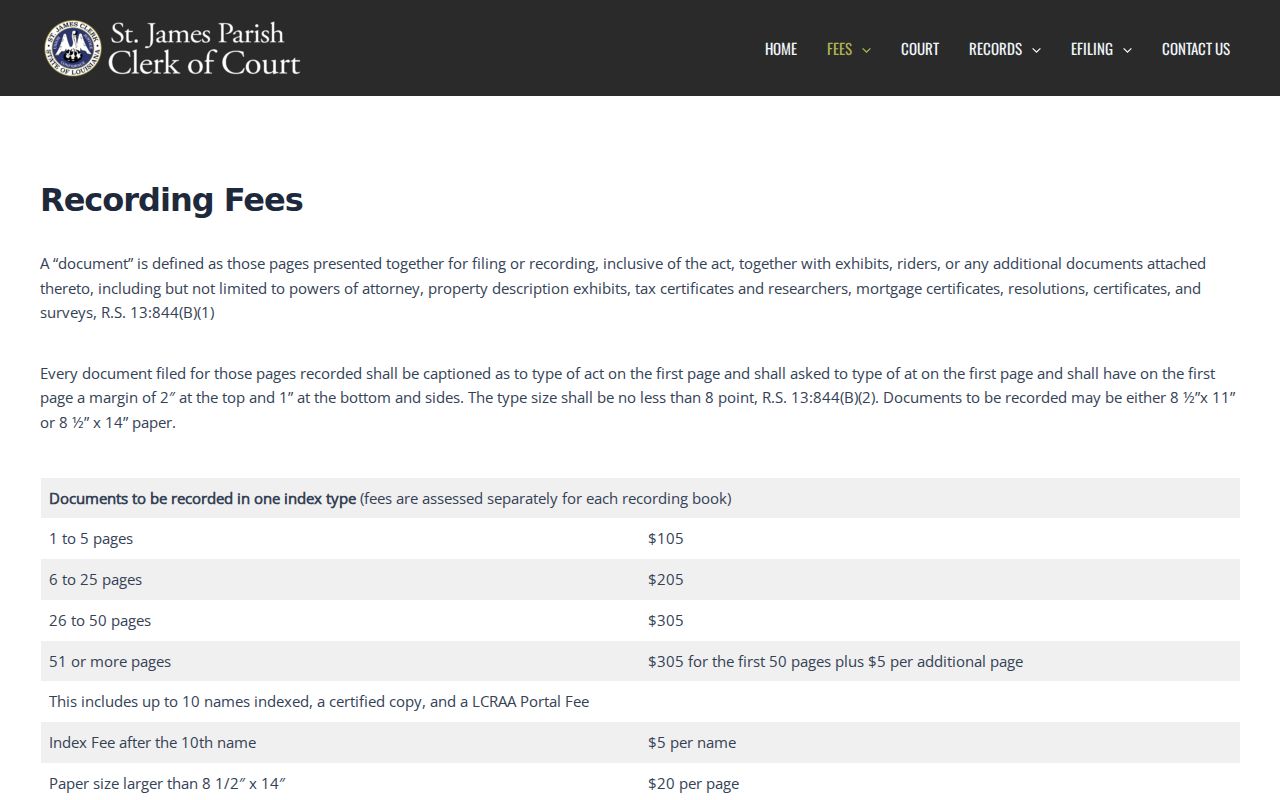
Those figures fit the recorded-document context where they appear. They are not a flat price for every St. James Parish court record. Note: A filing fee pays to start or advance a case. It is not a copy fee for a court file that already exists.
St. James Parish Court Records and E-Filing
E-filing in St. James Parish runs through CottFile. The Clerk ties it to the Louisiana Clerks of Court Association (LCRAA) electronic-filing path. Local procedures adopted in May 2025 say an electronically filed document joins the official court record once it is accepted. The same procedures cover PDF filing, acceptance, rejection, redaction, and what filers must do. Acceptance is not a promise, though. Not every accepted document is downloadable by the public, and public viewers cannot open every case.
For public requests, try CottFile only when it actually exposes the connected St. James matter you need. A standard public-record request stays the safer route for a docket, a signed order, or a certified document. Never repeat protected identifiers.
Sealed Records and Public Access
Public access stops somewhere. When a search comes up empty, the cause could be simple: the wrong court, a case older than digitization, a mayor's-court or justice-of-the-peace docket, a name spelled differently, or a file that is sealed, juvenile, or expunged. A missing result alone tells you nothing about what happened in the case. If one file blends public and protected material, ask for the reasonably segregable public portion. If access is denied, request the legal basis in writing.
Louisiana access rules:
C.C.P. art. 251 makes the clerk the court-record custodian and permits examination and copying during office hours except as law provides.
R.S. 44:31 recognizes the right to inspect, copy, or reproduce public records unless an exception applies.
R.S. 44:32 addresses inspection procedure, segregation of public material, and written determinations when public status is disputed.
R.S. 44:35 provides court remedies for an improper denial or delay under the public-records law.
An expunged record can leave public view without being destroyed, and juvenile material follows its own confidentiality rules. No open-records request overrides a sealing, an expungement, an adoption, or a juvenile restriction.
St. James Parish Court Records: No Result
Start with the court layer. A 23rd JDC case sits with the Clerk. A municipal matter may belong to Gramercy or Lutcher. A limited civil matter may sit in one of seven justice-of-the-peace dockets. Then check spelling, case year, division, and whether you want the docket itself or an attached paper. The Clerk's public land-record page cannot resolve a district-court search question.
Found the docket but not the document? Request the document on its own and ask how copies are made now. When you know enough to identify a case, the parish-wide St. James Parish case lookup route helps split the search step from the later copy request. For a current setting, confirm with the assigned division; a historic event on the docket is not the active date.
Note: Ask for the newest order or setting. That way an old docket entry is never mistaken for the current case status.