
Searching St. James Parish Criminal Dockets
Where does a St. James Parish criminal docket in the 23rd Judicial District Court (23rd JDC) live? Start with the St. James Parish Clerk of Court. The Clerk's public site offers no general criminal search. There is no lookup by name or case number. So figure out venue first. Is it a district case, a justice-of-the-peace matter, or a municipal one? For a district case, call the criminal side of the Clerk's office. Ask whether the record is public and how to inspect the docket.
re:SearchLA is a statewide Tyler-hosted search product. The Clerk's official pages do not list St. James participation. Test it only after venue is clear. An empty result is not a final answer. The product's own guide describes Cases, Filings, Text, and Hearings searches. Readers hunting a specific court file can also take the countywide case lookup route. Sort court ownership first, then request a docket.
- Gather the case number or citation, an approximate filing or offense date, the division if known, and the party role.
- Contact the criminal Clerk line and ask whether the matter is a public 23rd JDC record and which inspection or copy channel applies.
- Test re:SearchLA only after confirming that St. James records are included for the needed search type.
- Read dated docket events in order, then compare the newest setting with the latest order or division confirmation.
- Request a judgment, order, or certified copy separately when the docket points to that document.
- Use the listed lower court when the citation or case papers identify a mayor's court or justice-of-the-peace venue.
- For a restricted, expunged, or juvenile matter, ask the Clerk for the lawful access procedure rather than attempting to bypass it.
St. James Criminal Clerk Lines
The St. James Parish Clerk's published criminal numbers for district-court records are 225-562-2389 and 225-562-2271. The district-court counter sits at 5800 LA Highway 44, 2nd Floor, Convent, Louisiana 70723. Mail goes to P.O. Box 63, Convent, Louisiana 70723. Call before mailing anything. The Clerk publishes no criminal-copy form, payment route, or counter cutoff. The 23rd JDC lists general court hours. Treat those hours as broad guidance, not a promise for every records transaction.
St. James Parish Clerk of Court
5800 LA Highway 44, 2nd Floor
Convent, LA 70723
Criminal: 225-562-2389 or 225-562-2271
District-court criminal docket inspection, copy, and certification routing.
The 23rd JDC Division A page shows the court's division-level resources and contacts. A division can confirm a live setting. The Clerk remains the neutral keeper of the chronological court file.
Division resources help with scheduling questions. But a criminal docket request still needs the case's actual venue plus the Clerk's records process.
Inside a St. James Parish Criminal Docket
A criminal docket is a dated event trail, not an investigative file or a one-line criminal record. The parish publishes no sample docket for the public to study. Treat the fields described here as items to verify in a live Clerk record, not as a promise of what an online display will show. Remember the basic limits. A charge entry is not a conviction. A hearing notice is not proof the hearing occurred.
| Case number and filing date | Stable case identifier and the date of the initiating filing; the local format was not published. |
|---|---|
| Court and parties | 23rd JDC division, assigned judge where shown, and State/defendant roles, subject to access limits. |
| Charge and attorney | Offense, statute, classification, counsel, and bond information only if the record displays them. |
| Dated events | Arraignment, plea, motion, pretrial, trial, sentencing, order, reset, or other case activity. |
| Disposition and appeal | Outcome, date, judgment, transfer, or appeal entry when the case has reached that stage. |
Start with the newest entry and the most recent signed order. An earlier setting can linger as history after a continuance or reset. Local status codes and a local case-number pattern go unpublished, so labels like “pending” or “disposed” need confirmation from the live record.
St. James Criminal Charge Codes
The Louisiana Supreme Court's Single Charge search helps you understand a statute, ordinance, classification, or cost. It will not find a St. James case. The tool works from a court selector, an offense date, and search terms, plus advanced controls for law and charge categories. A ticket or citation number gets you nowhere there. The site takes no fine or ticket payments either.
| Control | Use | Local limit |
|---|---|---|
| Choose Court | Selects the court context | Does not prove a St. James case is filed |
| Date of Offense | Uses MM/DD/YYYY for cost context | Does not replace a docket date |
| Search Terms | Finds a statute or ordinance reference | Cannot search by ticket number |
The official charge-code screen states the database's search limits and cost context.
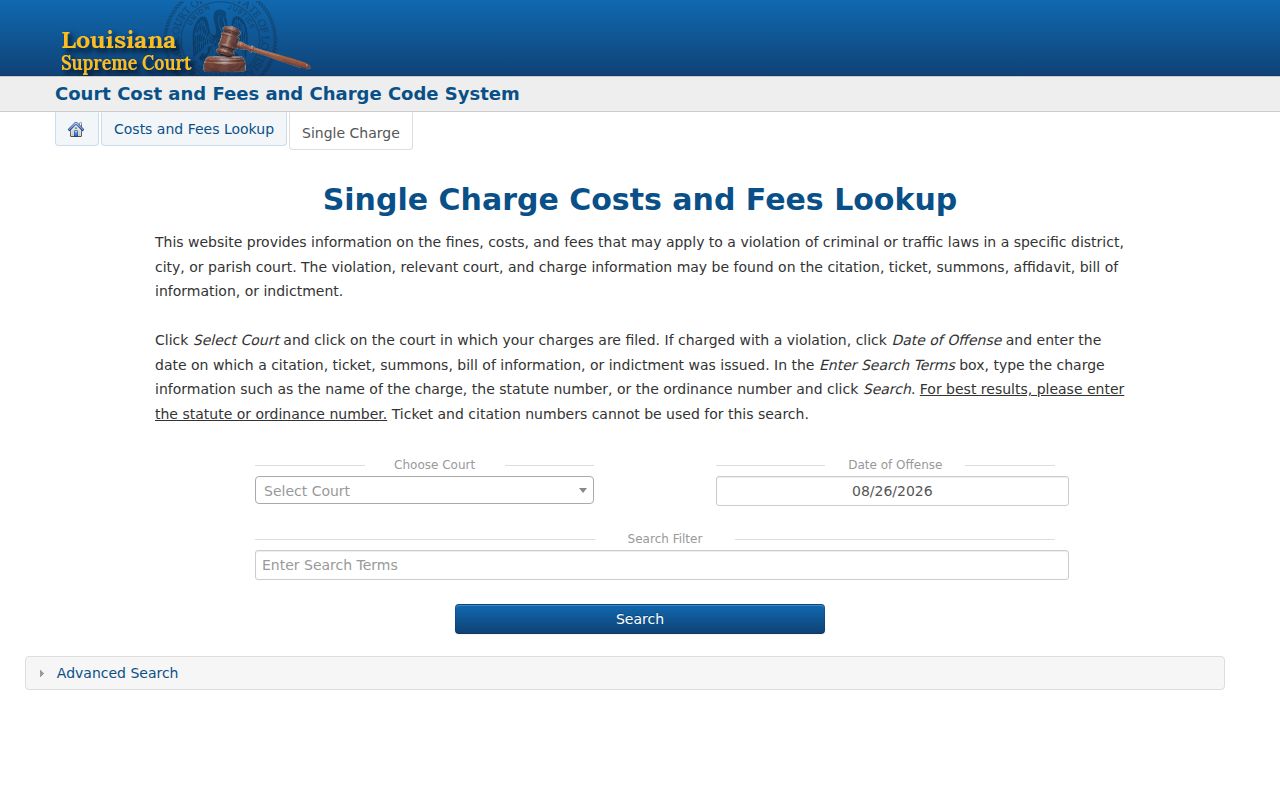
Use a code result to decode a label on a court record. Then verify the actual charge, setting, and disposition with the Clerk or the assigned court.
How a Criminal Case Moves
A felony-type 23rd JDC case can run from an initiating charge or bill of information to arraignment or appearance, plea, motions, pretrial or status work, trial or another adjudication, sentencing, post-judgment motions, and a possible appeal. That is a court-process model. St. James publishes no local list of docket codes. The division pages offer resources, but no complete local code or disposition dictionary exists for the parish.
Docket flow: Filing or charge → Arraignment or appearance → Pretrial or motion setting → Plea or trial → Disposition → Sentencing or appeal.
A later order can move a prior hearing. Before assuming an arraignment, pretrial setting, or sentencing event still stands, check the latest date, the most recent order, and the division's confirmation. Note: [local code not published] for St. James setting and disposition labels in an accessible register.
St. James Criminal Docket Limits
St. James publishes no public criminal docket sample free of private-party material. That gap matters. The lesson is simple. No one should invent a local case-number example, acronym list, bond field, or result screen. A blank re:SearchLA result can mean many things. It may reflect unconfirmed parish participation, a different venue, older paper records, a spelling variation, or a restriction. It does not settle whether the case exists or how it ended.
The 23rd JDC Division B page shows another division's public court resources. Those pages do not add up to a countywide criminal case register. Does a hearing seem reset or uncertain? Compare the docket history against the most recent order. Then contact the assigned division to confirm.
Division-specific contact material helps verify a setting. The Clerk's docket remains the court-record source for the event history.
Courts That Hold Criminal Dockets
Where a criminal case lives in St. James Parish depends on which court took it. The 23rd JDC handles district criminal work as the general trial court. Traffic is a different animal. Officer-issued Title 32 traffic and Title 56 wildlife citations in St. James can be randomly allotted among Divisions A through E under the local traffic-allotment rule. Town ordinance cases and justice-of-the-peace matters stay with their own courts unless an appeal or some other jurisdictional event moves them.
| Venue | Criminal docket role | First record route |
|---|---|---|
| 23rd Judicial District Court | District criminal cases and allotted state traffic matters | St. James Parish Clerk criminal line |
| Justice of the Peace courts | Separate limited-court and committing-magistrate functions | Ask the JP district that heard the matter |
| Gramercy or Lutcher Mayor's Court | Municipal-ordinance matters | Use the town court route, not the district docket |
| Federal court | Separate federal criminal record | PACER/CM-ECF, not the parish Clerk |
The 23rd JDC traffic-allotment rules cover how the district court handles certain state traffic citations. What they do not do is turn a town ordinance ticket into a 23rd JDC criminal docket entry.
St. James Criminal Filing Snapshot
State annual-report tables count 367 St. James criminal filings in 2024, then 405 in 2025. A filing count is just a count. It is not a public case list. It is not an active-case total or a statement about any person's case. Filings sit apart from jury trials in the same reports. The number of trials or convictions cannot be read from it.
Context is all the Louisiana Supreme Court annual report can give you. For a specific matter, you still need the live docket and the Clerk's copy process.
Sealed Dockets and Public Access
Louisiana law backs inspection of public court records, though access has limits. A public docket can list events yet skip document images. Certified copies are a separate clerk product. Does a request mix public and protected material? Ask whether the releasable part can be split out. And a public-records request never overrides a sealing, an expungement, or a juvenile restriction.
Louisiana access rules:
C.C.P. art. 251 identifies the clerk as custodian of court records and allows examination and copying during office hours, subject to law.
R.S. 44:31 recognizes the public right to inspect, copy, or reproduce records unless an exception applies.
R.S. 44:32 addresses inspection procedure, separation of public material, and written determinations when status is disputed.
R.S. 44:35 provides the court remedy framework for improper denial or delay.
C.Cr.P. art. 972 addresses expungement, art. 973 addresses confidentiality, and Children's Code art. 920 supplies juvenile confidentiality rules.
Expungement pulls a record from public view rather than destroying it. A parishwide public-records route is not the same as a court-docket request. Name the Clerk as custodian first. Dismissal is not expungement, and a pending charge is not a final outcome. If access is denied, ask for the lawful public or redacted portion. Request the legal basis in writing.
St. James Criminal Docket Requests
Ask for the record you actually need. The criminal docket gives you the chronological trail. A signed judgment or order may take its own plain or certified-copy request. A police report or investigative file is a different product entirely. The Clerk does not keep it as part of the complete court docket. The District Attorney prosecutes cases. It is not the neutral custodian of the full Clerk-maintained docket.
| Record sought | What it answers | Likely route |
|---|---|---|
| Public docket | Filed events, settings, orders, and recorded outcome | St. James Parish Clerk |
| Judgment or order | Text of a court ruling or certified proof | Separate Clerk copy request |
| Charge-code information | Statute, classification, or cost context | Louisiana charge-code database |
| Citation routing | Where a citation was sent | Issuing agency or listed court |
CottFile is the Clerk-linked Louisiana Clerks of Court Association (LCRAA) electronic filing and submission-status channel. Under the 2025 procedure, an electronic filing joins the official record when accepted, not merely when uploaded. Keep in mind that this rule creates no free public criminal register and no public document-download right.