
Searching the St. James Parish Court Docket
Figure out which court holds the case first. That single question drives every St. James Parish court docket search. The St. James Parish Clerk of Court handles records for the 23rd Judicial District Court. That court covers civil, criminal, family, and succession matters. Smaller civil claims may sit in one of the parish's seven justice-of-the-peace courts instead. An ordinance ticket from Gramercy or Lutcher often stays in that town's mayor's-court channel. Federal matters run through a separate system entirely. Get the venue right and a missing web result stops looking like a missing case.
Gather the most stable facts you can before searching: case or citation number, filing year, court or division, party role, and document type. With only a name in hand, note spelling variants. Also note whether the person is a plaintiff, defendant, petitioner, or respondent. The clerk's public site does not advertise one open civil-and-criminal name search. So the clerk-first route still matters whenever an online attempt fails to surface the St. James Parish court record.
- Classify the matter as a 23rd JDC, justice-of-the-peace, mayor's-court, or federal case.
- Gather the case number, citation, division, approximate date, and party role.
- Test re:SearchLA's Cases or Hearings scope only after checking whether St. James records are available there.
- Call the St. James Clerk to ask whether the public docket can be inspected and how to request a copy.
- Confirm an active setting with the assigned division or court, then request an underlying document separately when needed.
St. James Docket Search Without a Clerk Link
The official St. James Parish Clerk of Court site offers office contacts, e-filing, fees, and records resources. What it does not publish is a general district-court civil or criminal docket form. That gap shapes the whole St. James docket search path. Options include the clerk's Convent counter. Other routes are a telephone confirmation, a mailed request, or a written request to the proper custodian. A court date may also need confirmation from the assigned division itself, not just the clerk.
Statewide, re:SearchLA is worth testing, though it is no guaranteed St. James answer. Its quick-reference material describes Cases, Filings, Text, and Hearings searches. Filters, result details, and export tools are covered too. St. James participation is not confirmed, and direct access can hit a limitation. Treat an empty statewide result as a cue to recheck venue and the clerk. Never treat it as a conclusion about the case itself.
The Clerk of Court's public home page lays out the civil and criminal service routes. St. James district-court questions start there.
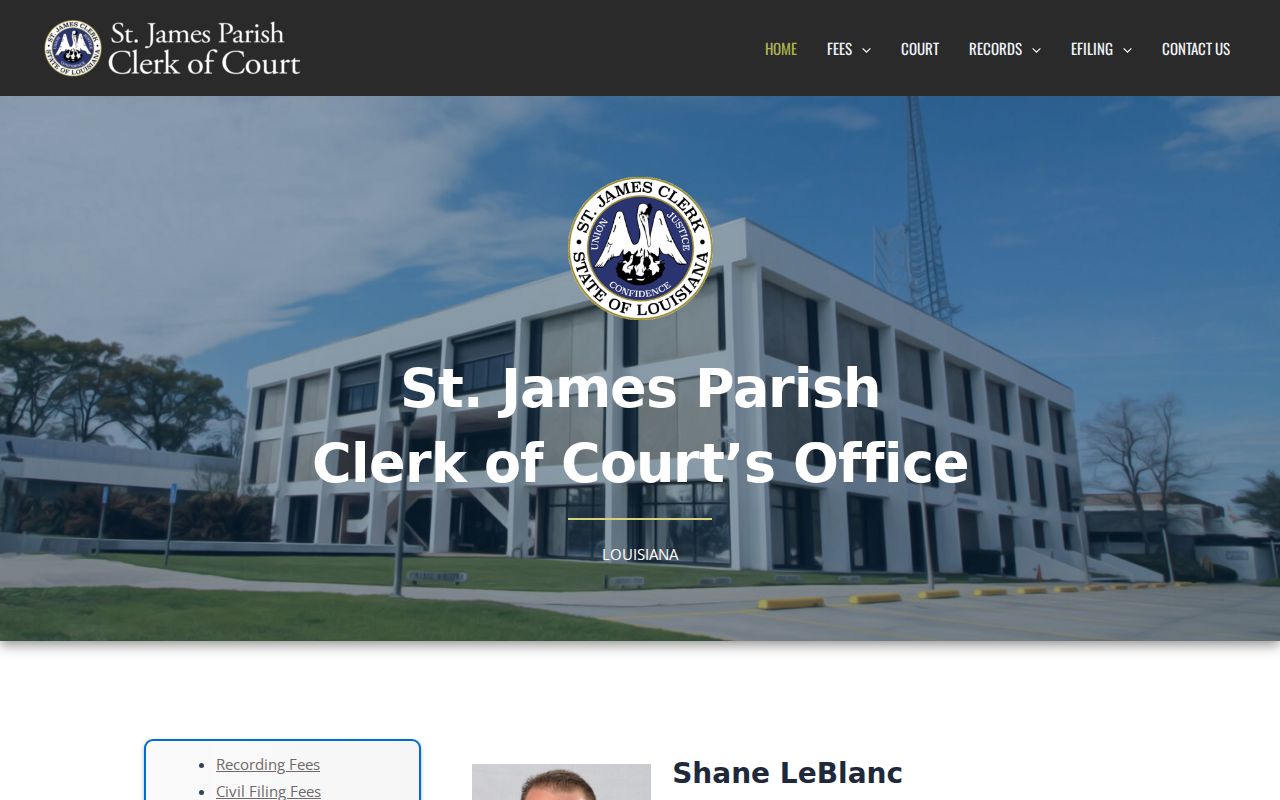
So the local clerk channel stays part of any St. James court docket search. Even with a statewide portal in reach, the clerk's office remains the dependable route.
Inside a St. James Parish Court Docket
Think of a St. James Parish court docket as a chronological trail of case events. It is not the full case file. When the record is public and the interface shows the fields, it can identify the court, division, parties, filing date, case type, setting, dated entries, orders, judgment, and appeal activity. No public St. James sample register exists to copy formats from. Verify the exact local case-number format, status codes, and display fields in the live record. Do not assume they match another Louisiana court.
| Case number | The stable case identifier. Its exact St. James display format was not published. |
|---|---|
| Court and division | The 23rd JDC and assigned division, or the lower court that owns the matter. |
| Parties and case type | Caption and roles, plus civil, criminal, family, traffic, or another category where public. |
| Docket events | Dated filings, notices, motions, orders, and other procedural entries in sequence. |
| Settings | Date, time, type, and location or remote details when the court makes them available. |
| Disposition | A judgment, dismissal, plea, sentence, or other outcome entry. A charge or filing alone is not a disposition. |
The documents sit behind that event trail. A petition, signed order, transcript, exhibit, or certified judgment can demand a separate request, a fee confirmation, or restricted access. The docket helps you locate and read the event history, but it does not promise a downloadable copy of every item.
St. James Land Records Are Not Dockets
The Clerk's official Records page covers conveyance and mortgage records only. It links land-record channels through LCRAA and Cott Hosting. Those tools serve recorded instruments and indexing. They are not a published St. James civil or criminal docket search. So a property-record hit, or a blank land-record result, says nothing about the status of a 23rd JDC case.
This split is the key local distinction. Someone chasing a district-court filing should call it what it is, a public docket, petition, judgment, or order. Then use the civil or criminal clerk route. Someone chasing a conveyance or mortgage record should use the records channel the Clerk names. Both functions live under the same elected office. Yet custody and search method depend entirely on the record layer.
The Clerk's contact page identifies the St. James court-records office route.
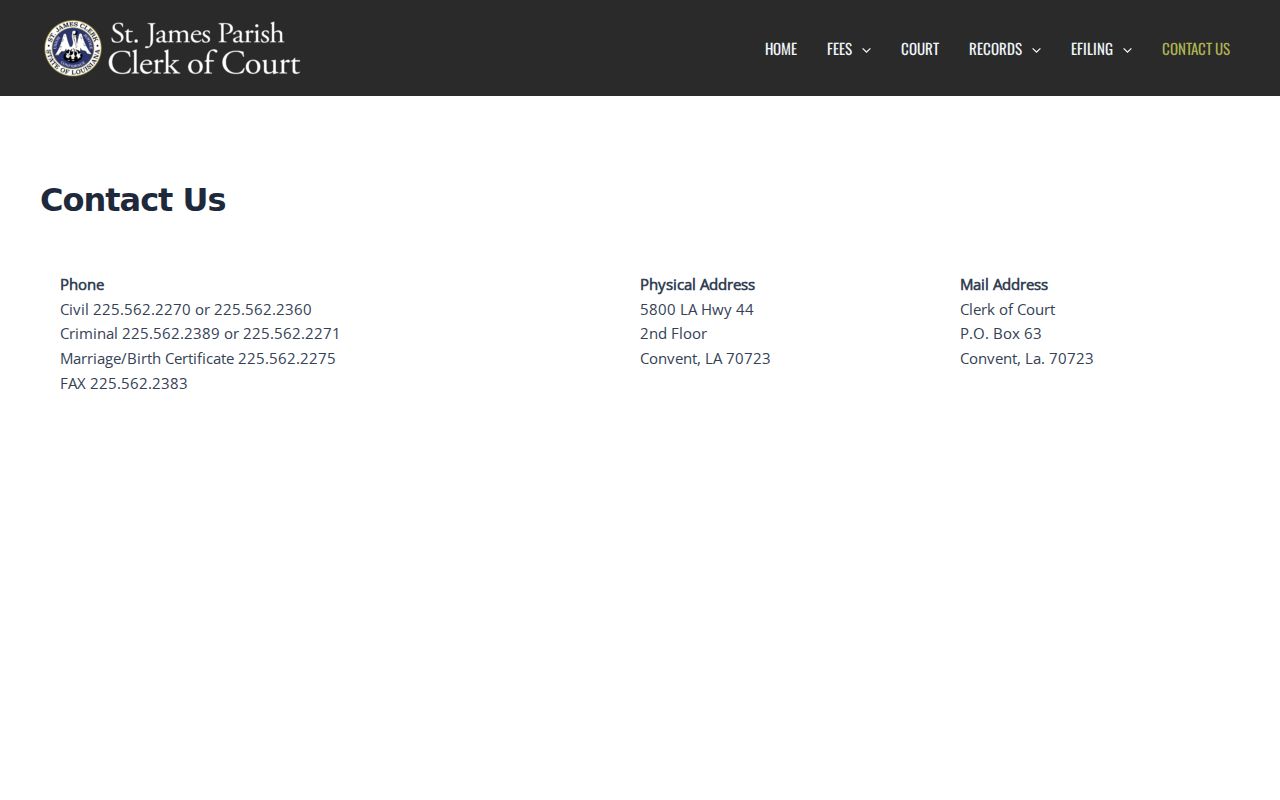
Route a St. James docket question through the published Clerk contacts. Aim it at the civil or criminal counter, not the land-record index.
Courts That Keep Dockets in St. James Parish
The 23rd Judicial District Court serves St. James, Ascension, and Assumption Parishes through six divisions, A through F. For any St. James district-court matter, the unified St. James Parish Clerk of Court is the practical records counter. The parish lists no separate parish court, city court, or stand-alone probate court. Lower courts and federal courts keep their own records, which is why a parishwide docket search starts with court routing rather than one assumed database.
| Court | Docket covers | Where to start |
|---|---|---|
| 23rd Judicial District Court | District civil, criminal, family, succession, paternity/support, and related matters. | St. James Parish Clerk civil or criminal channel; test re:SearchLA where available. |
| Justice of the Peace courts | Limited civil matters and statutory functions in the appropriate St. James district. | Contact the justice-of-the-peace office that heard the matter. |
| Gramercy and Lutcher mayor's courts | Municipal ordinance and town ticket matters. | Use the town court/payment route and confirm a court-record request with the town. |
| Eastern District of Louisiana | Federal civil, criminal, and bankruptcy-related matters. | Use PACER or federal CM/ECF information, not the parish Clerk. |
Appeals from the 23rd JDC head to the Louisiana Court of Appeal, Fifth Circuit. A state traffic summons can travel a different road: qualifying Title 32 traffic and Title 56 wildlife citations are randomly allotted among 23rd JDC Divisions A through E. Municipal ordinance tickets stay separate unless an authorized appeal or transfer changes the venue.
St. James Court Docket Filing Scale
The Louisiana Supreme Court's 2024 annual-report table offers one way to gauge how busy St. James courts are. It is not a case index. Instead, the table totals filings across several court categories. Those numbers explain why a St. James court docket can live in more than one court layer. Traffic and juvenile matters are especially prone to this split. What the totals cannot tell you is just as important. Nothing in them shows pending counts, the people involved, or whether any single case is still open. For that, you need the docket itself.
Treat the St. James row as court-system context, nothing more. The report notes that traffic, misdemeanor, juvenile, and family matters may be handled in different court layers. Any specific St. James docket must still be found through its court, clerk, or municipal channel.
How to Find Court Dates and Settings
A hearing date can surface in several places. You might see it on the St. James docket, a notice, a court order, a division communication, or the 23rd JDC Duty Calendar. Continuances, resets, reassignments, closures, and system updates can make these sources disagree. So read the latest signed order or notice first. Then check the docket history. Confirm the live setting with the assigned division or court coordinator. Keep in mind that a historic entry can linger in the record long after the appearance date moved.
The public division pages offer one route for confirming settings. Division E goes further, publishing a distinct Calendly workflow for family pre-rule status conferences. That tool separates existing cases from new ones. It emails the date, time, and Zoom details as a confirmation. It is not a party-name case search, though. A Calendly slot is also not a signed court order. The 23rd JDC home page posts local court notices. Its division resources fill in the rest.
Two counters matter here. The 23rd JDC's Convent location handles court-side setting confirmation, while the St. James Clerk serves as the district-records counter.
St. James Duty Calendar Limits
The 23rd JDC Duty Calendar is labeled official use only and displays Google Calendar embeds. It gives duty-judge context, but the court offers no general public case-number, party-name, or attorney search there. A duty judge schedule is not every St. James case setting. Use it as a confirmation aid alongside the docket, notice, and division. It is not a complete calendar search system.
A reset can leave an older hearing sitting in a chronological St. James docket. Compare the date and time. Compare the latest docket event and any signed order too. Do not rely on a single entry. A remote appearance may be authorized. When it is, the published 23rd JDC Zoom instructions put the meeting ID, passcode, and telephone details in the court communication itself. Do not infer a remote option from the older general instructions alone.
For a St. James setting that affects an appearance, the assigned division's current notice or signed order is stronger than an old calendar entry.
Public Access to Court Dockets
Louisiana law backs inspection and copying of public court records. Access still depends on the record and any specific restriction. Under C.C.P. art. 251, the clerk is the legal custodian of court records. The state's public-records provisions recognize inspection and copying rights. They set rules for custodians. They also let a requester demand a written legal basis when a record's public status is disputed. Even so, none of that guarantees every filed image. It does not promise instant online delivery. Sealed, juvenile, expunged, or confidential material stays out of reach.
Louisiana access rules:
C.C.P. art. 251 identifies the clerk as court-record custodian and provides for public examination and certified copies subject to law.
R.S. 44:31 recognizes inspection and copying rights unless an exception applies.
R.S. 44:32 addresses custody, segregation of public material, and a written determination when status is disputed.
R.S. 44:35 sets out judicial remedies for an improper denial or delay.
When a request mixes public and protected material, ask the St. James custodian for the public portion alone. A browser printout, an e-filing download, and a clerk-certified copy each serve a different purpose. And the Clerk's land-record copy prices are not the price of every district-court docket or document.
When a St. James Docket Search Fails
A blank result does not mean no St. James case exists. The record may sit in a mayor's court or justice-of-the-peace docket. The statewide service may not include St. James. The case may predate digitization, or the name may be indexed differently. The matter may also be restricted. The Clerk's online land-record page also has a narrower scope than a district-court docket search. None of this touches the merits of a case. These are venue and access questions, full stop.
So work the problem. Check the court named on the paperwork. Compare spelling and party role, and ask the clerk whether a public docket can be inspected. If access is restricted, ask which authority controls it. Ask whether a segregable public portion exists. Louisiana expungement provisions pull covered records out of public view without necessarily destroying them. Juvenile records carry their own confidentiality rules. A public-records request does not override those boundaries.
Note: Ask for the public docket or a specified public document. Do not ask for an undefined all-records search. The St. James custodian can then identify the right legal file.
Docket Records at the Clerk's Office
Every St. James Parish district-court record runs through one office: the St. James Parish Clerk of Court. The Clerk serves as the unified clerk for the parish side of the 23rd JDC. Civil, criminal, family, and related filings all land at this counter. The office publishes separate phone lines for civil and criminal questions. When you request a copy, give the case number if you have it. Add the court or division, the rough date, and the type of record. Say what you need: inspection, a plain copy, or certification.
Fees need a quick check too. The Clerk's site posts civil filing fees and charges for recorded documents. It posts no universal fee schedule for plain copies, certified copies, searches, or electronic documents in St. James district court. Call to confirm the amount, the payment method, and the certification requirement. Do this before you send money. Mail to the Clerk's published address works. The office does not state a standard court-copy submission form or a transaction cutoff time.
St. James Parish Clerk of Court
5800 LA Highway 44, 2nd Floor
Convent, LA 70723
Civil: 225-562-2270 or 225-562-2360
Criminal: 225-562-2389 or 225-562-2271
The 23rd JDC contact page handles something different. It routes calls to divisions and judges' offices, which helps when you need a setting confirmed. It cannot take the Clerk's place for copies and record requests.
One case can require two calls in St. James Parish. Docket requests and setting questions sometimes go to different offices, so ask the Clerk which contact handles which task before you chase a court date.
St. James CottFile Filing Status
For electronic filing, the St. James Clerk points both criminal and civil filers to CottFile. It handles e-filing and submission tracking in Louisiana. It offers attorney and public accounts. Filing tools, document management, and status tracking are there for connected courts. None of that adds up to an open St. James guest docket viewer. A case may not actually be displayed there. Confirm access with the Clerk first. Do not treat the service as your source for a public docket or a copy.
Local e-filing procedures adopted May 12, 2025 also draw some lines worth knowing. An electronically filed document joins the official court record only once it is accepted. The rules require PDF submissions and leave redaction to the filer. A submitted document is not always an accepted filing. A case-status account does not equal a public-record delivery system. The CottFile documentation spells out the filing and status tools. Those tools tie to the Clerk's electronic filing path.
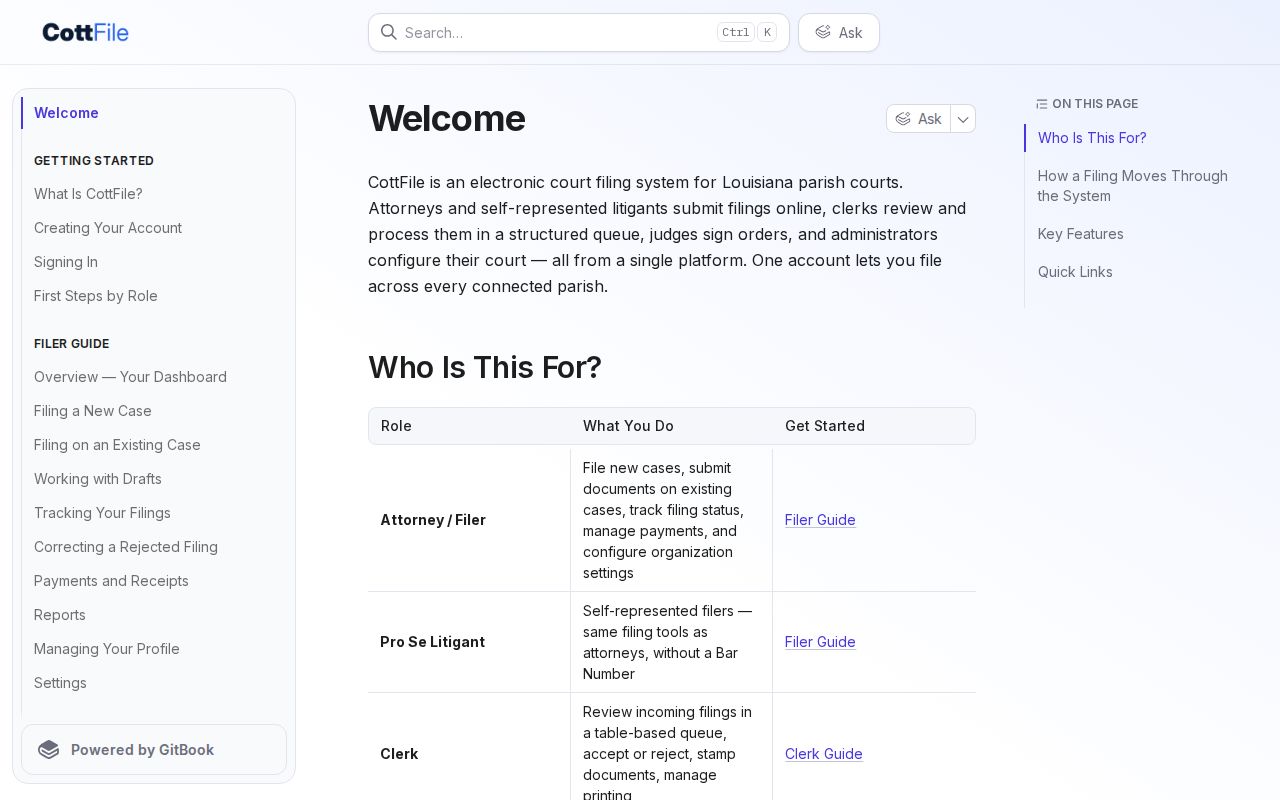
E-filing explains how papers get into a St. James court record. It does not make CottFile a public docket database, so treat the two as separate things.
St. James Court Docket Routing
St. James Parish public services split their duties. Routing matters. Parish government handles general public-records information. The Clerk remains the likely home for any district-court docket. Below the district court sits another layer. The parish's official Justice of the Peace directory lists seven separate JP offices. Each is its own limited-court contact point. An older district file, a land instrument, a JP case, and a parish-government record may sit with four different custodians. Send each request to the office that actually keeps that layer. The St. James Justice of the Peace directory names those lower-court contacts.
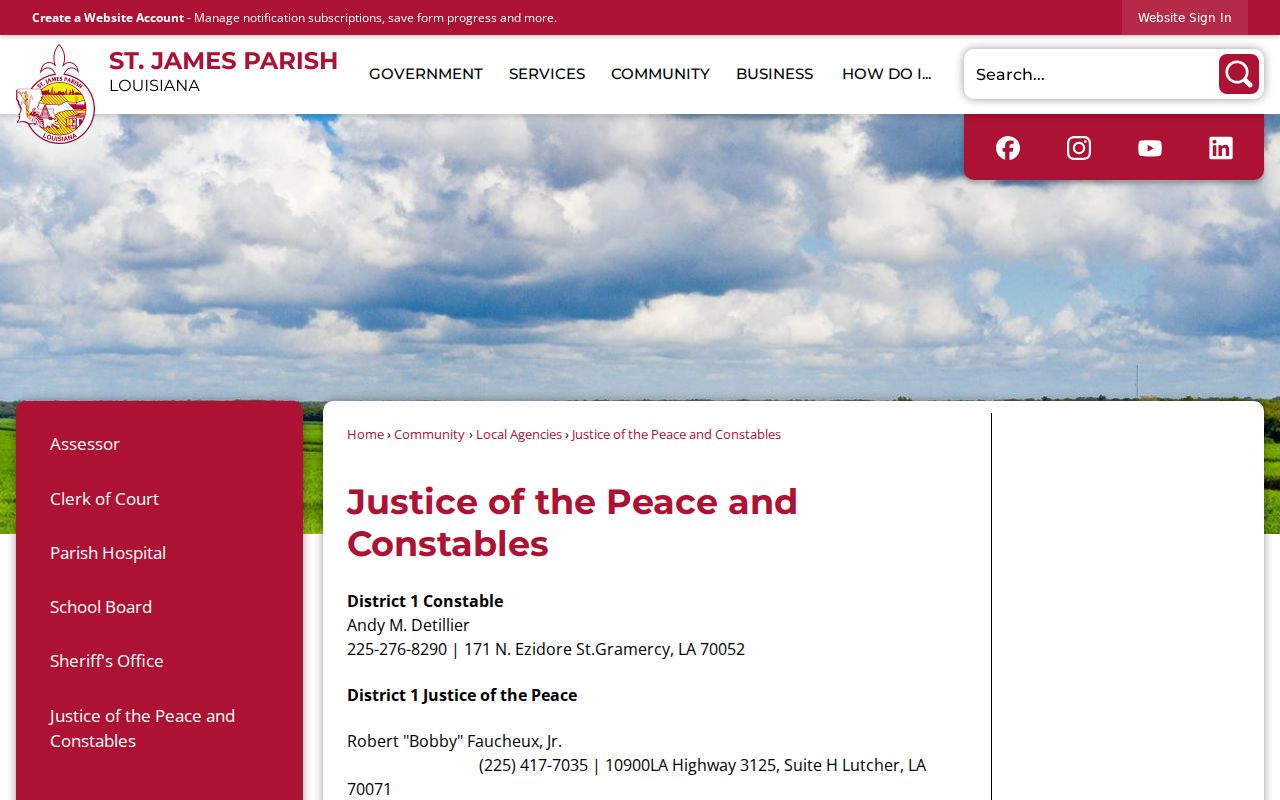
A St. James justice-of-the-peace docket lives with the JP district that heard the case. Do not assume a limited civil matter appears in the district-court register, because it usually will not.
St. James Parish Court Dockets by City
St. James Parish has two incorporated towns, not five city pages. The official 2020 Census place table sets that count. Lutcher and Gramercy each run a mayor's-court channel. It handles municipal matters. Those ticket routes differ from the district-court docket kept through the St. James Clerk. A town portal can point you to a payment or ticket channel, but it cannot promise a full municipal docket sheet or a certified court record online. For anything beyond ticket handling, the district-court route through the Clerk remains the sure path.
Lutcher Docket Search
3,133 residents in the 2020 Census. Lutcher uses an nCourt payment/contact route for town tickets.
Gramercy Docket Search
2,932 residents in the 2020 Census. Gramercy uses a QuickCourt ticket lookup/payment route.
The St. James Parish government site covers public services, separate from the court and clerk channels.
The city pages distinguish municipal ticket channels from the St. James district-court record route.
Map and Directions to the St. James Parish Courthouse
23rd Judicial District Court civil, criminal, and family records for St. James Parish are kept at the Clerk of Court's office on the second floor of the Convent courthouse, 5800 LA Highway 44. The building is a three-story structure that also houses the 23rd JDC's St. James divisions and the District Attorney's office.
St. James Parish Clerk of Court
5800 LA Highway 44, 2nd Floor
Convent, LA 70723
Civil: 225-562-2270 or 225-562-2360
Criminal: 225-562-2389 or 225-562-2271
Monday through Friday, 8:30 a.m. to 4:30 p.m.
Call the civil or criminal line first to confirm the counter and current hours, since the clerk's pages do not publish a separate records-counter closing time. The official sources reviewed do not describe courthouse parking, a public docket terminal, or security-screening procedures, so those should be confirmed by phone before a visit.